
Incentivized reaching
SUMMARY
Lead
Neil M. Dundon
PI
Scott T. Grafton
Subjects
68 healthy subjects, age 18 to 26
Data types
behavior, fMRI
Institution
UC Santa Barbara
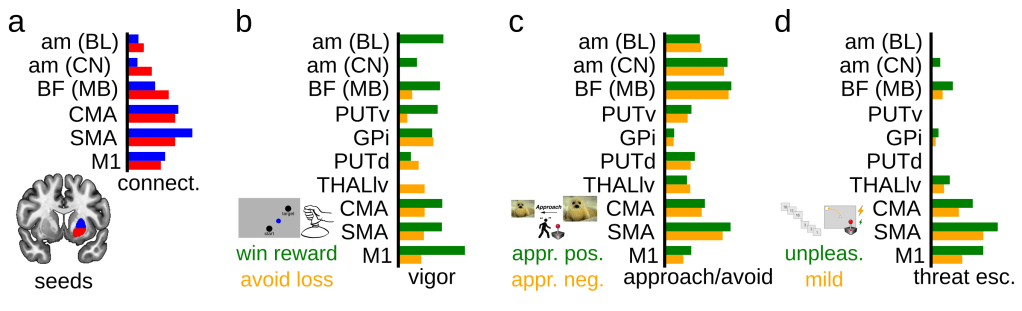
One of the most important—if not the most important—goal-directed behavior is initiating a physical movement. Do we initiate movements faster to pursue large reward, or to avoid large losses? In this dataset, 68 people took part in an incentivized reaching task where they used a joystick to reach for targets on a screen. Each person did 3 runs of 100 trials. During each trial, they had to precisely move the joystick to a target on the screen and hold it there for one second to succeed. They had 1.87 seconds to complete this task from when they were given the go signal. This time limit was set so that, on average, participants would succeed 50% of the time. At the start of each trial, they positioned a cursor at a starting point on the screen. An instruction then informed them which of two targets they needed to move the cursor to, and indicated what they could earn from that trial. In 80% of the trials, called “standard” trials, they could earn 20 cents if they succeeded, and nothing if they failed. The other 20% were “high incentive” trials, split into two types: “Jackpot” trials (10% of the total), where they could earn $1.60 for succeeding or nothing for failing. “Robber” trials (another 10%), where they could avoid losing $1.60 if they succeeded, but would lose it if they failed. After a waiting period, a signal told them to reach for the target. Once they made their move, they received visual feedback on whether they completed the trial successfully within the time limit.
Publications
Dundon, N. M., Rizor, E., Stasiak, J., Wang, J., Sabugo, K., Villaneuva, C., Barandon, P., Bostan, A. C., Lapate, R. C., & Grafton, S. T. (2024). Dissociation of novel open loop from ventral putamen to motor areas from classic closed loop in humans II: Task-based function. bioRxiv, 2024-06.
 SKIP
SKIP 