
Approach-avoid
SUMMARY
Lead
Jingyi Wang
PI
Regina C. Lapate
Subjects
78 healthy subjects, age 18 to 26
Data types
behavior, fMRI
Institution
UC Santa Barbara
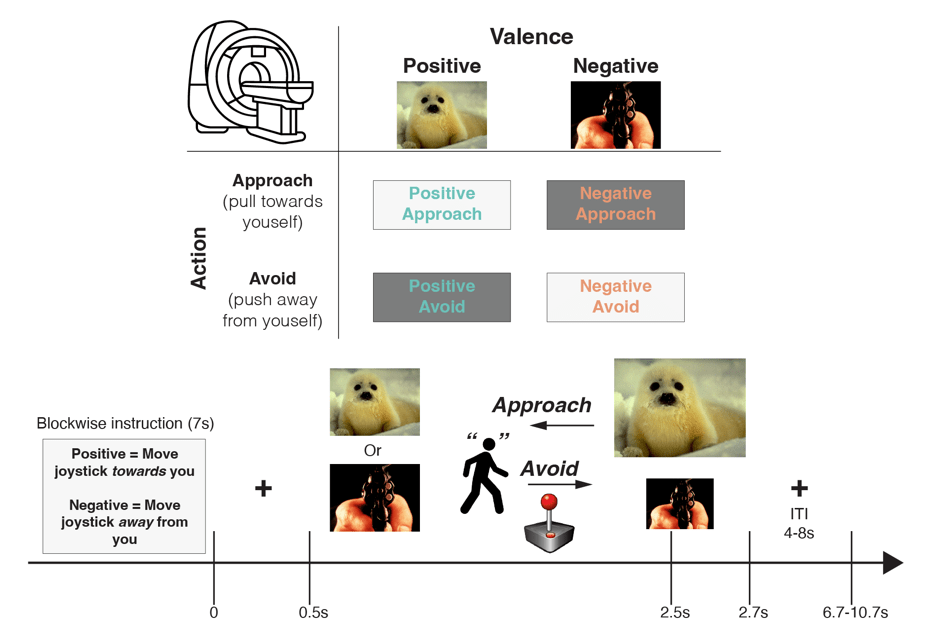
In the approach-avoidance task, participants viewed emotional pictures and were asked to make a time-constrained movement using the joystick. We orthogonally manipulated the valence (Positive and Negative) of the pictures and the goal of the joystick movement direction (Approach and Avoid). Briefly, participants were instructed to either pull the joystick towards themselves (approach) or away from themselves (avoid) according to the valence of the image. This manipulation creates both emotion-action congruent conditions (Positive-Approach, Negative-Avoid) that the action goal aligned with emotion inclination and the emotion-action incongruent conditions (Positive-Avoid, Negative-Approach) that the action goal and emotion went against each other.
Publications
 SKIP
SKIP 